

Why your network will decide whether AI actually delivers in your Warehouse or Factory
In this blog we discuss how AI, Automation, and Robotics are only as good as the Network beneath them
AI and automation programmes stall at “pilot” when the network is treated as general office connectivity rather than production infrastructure. As you scale vision systems, autonomous devices, and shop-floor data collection, the site needs reliable wired + Wi‑Fi foundations, clear segmentation between IT and OT, and enough visibility to prove where performance is breaking. Without that, you get intermittent faults, unreliable telemetry, and teams stop trusting the data — even if the AI models are good.
TL;DR (what to do first)
- Identify the 3–5 operational workflows that must not fail (vision, robots, scanning, line-side updates, safety-adjacent telemetry)
- Define acceptance criteria (latency/jitter/loss + coverage + roaming behaviour)
- Segment traffic so production-critical flows are protected and faults are contained
- Validate performance in real operational routes (not only static tests)
- Build monitoring and evidence (before/after), so improvements are provable
Connected Factory (overview)
For the architectural overview this sits within, see: Connected Factory.
Introduction
AI, automation, and robotics are moving from trade‑show demos into real warehouses and factories.
Mid‑market businesses are starting to use:
- Computer vision to spot defects on the line
- Intelligent picking and packing in the warehouse
- Predictive maintenance to avoid unplanned downtime
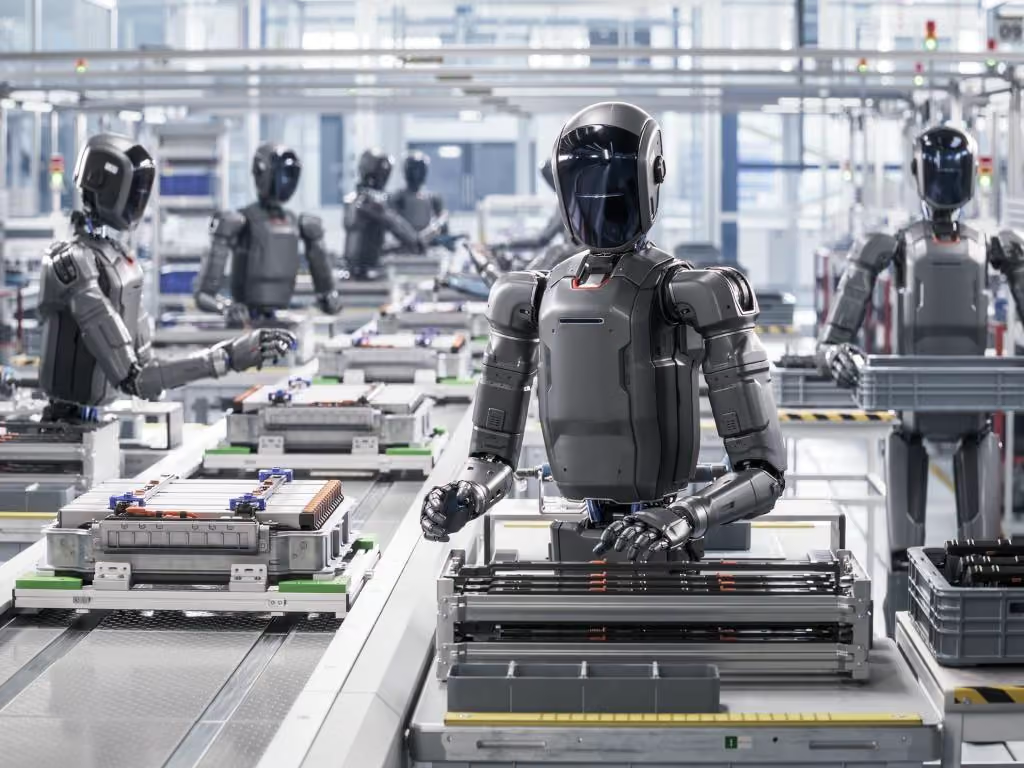
- Autonomous or humanoid robots to move goods and handle repetitive tasks
The question is no longer “Will AI change our sector?” but “Will we use it better than our competitors?”
There’s a less glamorous reality underneath all of this:
If your wired and Wi‑Fi network is fragile, none of these AI initiatives will scale beyond a pilot.
In large sheds, where everything is spread out and constantly moving, networking is already hard. As you add AI and advanced automation, it becomes mission‑critical.
This article looks at three trends:
- AI in modern warehouses and factories
- Humanoid and autonomous robots as a practical tool, not a gimmick
- AI moving to the “enterprise edge” with partnerships like Cisco and NVIDIA
…and explains why IT and operations leaders need to treat the network as core production infrastructure, not just office plumbing.
1. AI on the Shop Floor and in the Shed: From Nice‑to‑Have to Business‑Critical
For mid‑market companies, AI is no longer purely strategic. It shows up in very practical use cases:
- On the line: cameras watching for defects, models predicting scrap, systems suggesting parameter changes to keep quality on track.
- In the warehouse: slotting optimisation, pick‑path optimisation, and AI‑assisted labour planning.
- In maintenance: models that flag when a key conveyor, motor, or chiller is likely to fail.
What this means for IT leaders
Every one of these use cases depends on moving data reliably:
- High‑resolution camera feeds across the warehouse or factory.
- Sensor data from PLCs, SCADA, and building management.
- Real‑time feeds into AI models running on‑site or in the cloud.
If Wi‑Fi drops in key areas, or if the backhaul is saturated:
- Vision systems silently fall back to “best effort” or simply stop.
- Real‑time dashboards start lagging, so the operations team stops trusting them.
- Maintenance teams get alerts too late to avoid disruption.
The business impact is simple: AI becomes another pilot that never quite becomes “how we run the site”.
What this means for operations leaders
Operational leaders care less about how AI works and more about:
- Fewer missed shipments
- Shorter turnaround times
- Less unplanned downtime
- Better resource utilisation
Those outcomes rely on consistent, timely data from the floor. That data rides on the same network that currently handles laptops, handhelds, label printers, scanners, and voice headsets.
If the underlying network is shaky, AI looks like a broken promise: lots of slideware, little impact.
2. Humanoid Robots and Fleets of Autonomous Devices
Videos of humanoid robots from Boston Dynamics and Tesla get attention because they look futuristic. For warehouses and factories, the more relevant idea is this:
Once you teach one robot a task, the whole fleet can learn it.
That has two important consequences.
Fleet‑level skills need fleet‑level connectivity
Today, you might train one picker or one machine operator at a time. Robots are different:
- You develop and test a task once.
- You push that “skill” to every compatible robot.
- You monitor performance and feed data back into the model.
This requires:
- Reliable connectivity between robots and central systems.
- Secure distribution of updates across the site (or multiple sites).
- Continuous telemetry from the fleet for optimisation and safety.
If Wi‑Fi is patchy in parts of the warehouse, you risk:
- Robots on different versions of behaviours.
- Partial updates or rollouts failing mid‑task.
- Gaps in telemetry that make it hard to prove safety or troubleshoot incidents.
Real‑time coordination in big, busy sheds
In large sheds and mixed environments (forklifts, people, AMRs, tugs):
- Robots must avoid collisions and congestion.
- Systems must factor live conditions into routing and task allocation.
- Safety interlocks must be trusted to work every time.
That demands:
- Low‑latency connectivity where it matters (eg. transfer points, choke points, loading bays).
- Coverage designed for moving devices and tall racking, not just desks.
- Segregation between robot traffic, guest Wi‑Fi, and general office use.
For both IT and ops, the message is the same: the moment you deploy fleets of autonomous or humanoid robots, your network stops being “background IT” and becomes part of your materials‑handling equipment.
3. Cisco, NVIDIA, and AI at the Edge: Why It Matters.
Partnerships like Cisco’s with NVIDIA reflect a clear shift: run AI as close as possible to where the data is generated instead of pushing everything to the cloud.
For a typical mid‑market site, this has very practical advantages:
- Lower latency: Decisions for robots, conveyors, and quality systems can be made on‑site.
- Resilience: If the site’s internet connection struggles, the core of the operation can still function.
- Cost control: You do not have to ship every video frame and sensor reading across a WAN link or into the public cloud.
But it also raises the bar for the local network:
- Edge AI servers and appliances sit on your network and depend on it.
- Traffic inside the site (device‑to‑edge, east‑west) grows dramatically.
- Security requirements increase: these edge systems are now high‑value targets.
For IT leaders, that means:
- Designing the LAN and WLAN explicitly for AI and OT traffic, not just office use.
- Planning capacity for growth in internal data, not just internet bandwidth.
- Building proper segmentation between OT, IT, and guest networks, with policy enforcement that can keep up.
For operations leaders, the important bit is: this is how you make AI dependable. Edge architectures, done properly, help keep operations running in spite of cloud or WAN issues—if the underlying network is up to the job.
4. Why Large Sheds Make Networking Harder (and More Important)
Warehousing, logistics, and manufacturing sites share some awkward physical realities:
- Very large floor areas with varied usage (racking, production, marshalling, offices).
- High ceilings, metal racking, and machinery that interfere with radio signals.
- Constant movement: pallets, vehicles, temporary structures, seasonal layouts.
This environment is already difficult for:
- Handheld scanners
- Voice headsets
- Label printers
- Forklift‑mounted terminals
When you add:
- High‑definition cameras
- Autonomous robots
- Edge AI appliances
…the room for error disappears.
For mid‑sized IT teams who often run lean, this creates a real risk:
- The business invests in AI and automation pilots.
- They work in a small corner of the operation.
- When scaled across the full shed or multiple sites, the underlying network buckles.
This is where IT and operations leaders need a shared view: if networking is not treated as a production asset, AI will not deliver production‑grade results.
5. Reframing the Network: From Cost Centre to Production Asset
Historically, networks in mid‑market firms have been budgeted as overhead. The instinct has been to “sweat the asset” for as long as possible.
In an AI‑enabled warehouse or factory, that mindset becomes a competitive disadvantage.
- Your network is how data flows from line to model to decision.
- Your data is how your AI works.
- Your AI is how you differentiate on cost, speed, and reliability.
Under‑investing in the network is, effectively, under‑investing in operational efficiency and customer experience.
A more helpful framing for both IT and ops:
- Treat wired and wireless networks like production machinery.
- Plan capacity, redundancy, and lifecycle in line with production goals, not office refresh cycles.
- Measure network performance in operational terms: missed picks, line stoppages, SLA breaches, not just “up/down”.
6. Practical Next Steps for IT and Operations Leaders
If you are an IT or operations leader running a mid‑sized warehouse or factory, some concrete steps:
- Map critical AI and automation use cases
- Where do AI and automation already touch live operations (or pilots)?
- Which devices, lines, and zones are truly “production‑critical”?
- What is coming next 12–24 months (robots, more vision, more sensors)?
- Assess current network readiness in those areas
- Do you have known coverage blackspots in aisles, loading bays, or yards?
- Are there single points of failure in switches, controllers, or backhaul links?
- Can you see, in real time, whether handhelds, robots, and cameras are struggling?
- Prioritise investment where operations feel the most pain
- Start with the lines or zones that cause the most disruption when they fail.
- Fix obvious Wi‑Fi issues (design, density, interference) before layering AI on top.
- Segment production traffic away from guest and office usage.
- Design explicitly for edge AI
- Assume you will be running more AI workloads on‑site.
- Ensure the network between machines, cameras, and edge compute has headroom and redundancy.
- Build in visibility from day one: if something slows down, you need to know where and why quickly.
- Create a joint IT–Ops view of risk and value
- Translate network issues into operational language: missed cut‑off times, missed OTIF targets, safety near‑misses.
- Agree that AI and automation are not “IT projects” but business change programmes that depend on the network.
Conclusion
For mid‑sized warehousing, logistics, and manufacturing businesses, AI and advanced automation are no longer optional experiments. They are fast becoming the way your most efficient competitors operate.
But they all share the same, easily overlooked dependency:
If your wired and wireless network is not designed and run as production infrastructure, your AI investments will never fully pay off.
The winners in this next phase will be the organisations where IT and operations leaders work together to treat networking as a strategic asset—one that quietly underpins every robot, every camera, and every AI‑driven decision on the floor.
Next step
If you’re planning AI/automation rollout or scaling beyond a pilot, email solutions@oxspring.com with subject “AI-ready network” and include the site type, the use cases you’re scaling (vision/robots/data collection), and the areas where reliability or performance is currently limiting you. We'll get in touch to arrange a free, no-obligation initial Teams call to see if we can help you achieve your goals.
