

A Connected Factory treats wired, wireless and security infrastructure as part of production. Oxspring designs, installs and supports resilient factory networks that connect people, machines and systems without allowing a local fault, weak wireless link or uncontrolled access path to disrupt the wider operation.
Who is Connected Factory for?
Connected Factory is for operations, engineering and IT leaders responsible for manufacturing sites, process environments and multi-site production estates. It is particularly relevant when:
- ERP, MRP or MES platforms are extending onto the shop floor
- scanners, tablets, printers, HMIs or engineering devices need dependable mobility
- production data is delayed, incomplete or difficult to trust
- separate machine, automation and building-system networks have grown without a common architecture
- IT and OT systems need to exchange data without flattening security boundaries
- suppliers require controlled remote access to production equipment
- robotics, machine vision, AGVs, AMRs, IIoT or edge AI are moving beyond a pilot
- a network refresh must improve resilience without creating unacceptable production risk
- several factories need repeatable standards while retaining appropriate local differences
What should a factory network achieve?
A factory network should help production continue safely and predictably while making operational change easier to control. A well-designed environment supports:
- Greater production resilience, with critical paths designed around the consequence of failure
- Dependable shop-floor data, so ERP, MRP, MES, quality and maintenance systems reflect what is happening
- Controlled IT/OT convergence, with deliberate communication paths between production, engineering and enterprise services
- Reliable mobility for people, HMIs, scanners and appropriate automated equipment
- Safer supplier and contractor access, limited by identity, purpose and time
- Faster fault isolation, with evidence that helps teams distinguish network, device, application and process problems
- Predictable expansion when adding a line, cell, device type, site or digital service
- A credible foundation for automation and AI, based on tested data paths rather than assumptions
What does “Connected Factory” mean?
Connected Factory is an architectural approach, not a single product. It joins the plant LAN, industrial and enterprise wireless, fibre backbone, WAN, security controls and operational monitoring around the needs of production.
The objective is not to connect every device to everything else. It is to give each person, machine and system the connectivity it needs, contain faults and threats, and make permitted data flows visible and supportable. This helps the organisation avoid a patchwork in which every machine supplier, BMS provider or digital platform introduces another isolated network with different ownership and security assumptions.
Why is factory networking different from office networking?
A factory network carries traffic with very different consequences. It may connect PLCs and PACs, HMIs, machine-vision systems, engineering workstations, sensors, scanners, robots, quality systems and enterprise applications. Some workloads tolerate delay; others affect production continuity or require tightly controlled behaviour. A design must therefore begin with the process, data flow and consequence of failure rather than an office bandwidth model.
The physical environment also varies by zone. Metal machinery, moving equipment, electromagnetic interference, dust, moisture, washdown areas, temperature extremes and hazardous locations can affect cabling, enclosures, antennas and equipment selection. Industrial-grade hardware is justified where the conditions require it, not simply because the building is called a factory.
Change is another important difference. Production assets may remain in service for far longer than ordinary IT equipment, and maintenance windows can be scarce. New controls must coexist with legacy protocols, specialist suppliers and operational safety arrangements. Migration, testing and rollback are therefore part of the architecture, not project administration added at the end.
The six foundations of a Connected Factory
1) Resilient plant infrastructure
The wired LAN and fibre backbone provide the foundation for production systems, wireless, cameras, building services and edge platforms. We design core, distribution and access layers around critical zones, suitable power and PoE capacity, environmental conditions and the operational impact of a failed device or link.
Resilience should be selective and testable. Critical paths may justify diverse uplinks, redundant equipment, protected power and rapid failover, while lower-impact areas may need a simpler design. The objective is to prevent one cabinet, cable or maintenance event from causing wider disruption without adding complexity that the site cannot support.
2) Deliberate IT/OT boundaries
Production, engineering, corporate, supplier, IIoT and guest traffic should not share unrestricted access because they use the same physical infrastructure. We map required flows and use appropriate segmentation, identity controls and security policy to define who or what may communicate.
An industrial DMZ can provide a controlled exchange point between plant OT and enterprise IT. Certificate-based access, network access control and time-bounded supplier permissions can reduce exposure while preserving the access needed to operate and maintain the site. The practical test is whether the organisation can explain each permitted path, its owner and how it will be reviewed or removed.
3) Wireless chosen for the workload
Factories may need several kinds of wireless connectivity. Well-engineered Wi‑Fi can support operator devices, mobile HMIs, scanners, tablets, maintenance access and many general-purpose workloads. Mobility-critical equipment may justify a more specialised approach, such as ultra-reliable wireless backhaul or private cellular, when bounded latency, resilient paths or indoor-to-outdoor continuity are genuine requirements.
The choice starts with the application and its tolerance for interruption. We assess the real RF environment, client height, movement routes, interference and device behaviour, then validate coverage, roaming and application performance under representative conditions. More access points or a newer Wi‑Fi generation will not compensate for unsuitable placement, antennas or acceptance criteria.
4) Trusted shop-floor data paths
ERP, MRP, MES, quality, maintenance and analytics programmes depend on consistent data from the floor. We map the end-to-end path from devices and controllers through the plant network to local, enterprise or cloud services, including the boundaries where ownership changes.
This helps expose hidden dependencies before they become intermittent faults. A missed scan, delayed quality record or stale dashboard may originate in RF design, authentication, switching, routing, WAN performance or the application itself. Treating the data path as one service makes it easier to design appropriate resilience and identify the real cause when performance changes.
5) Connectivity for automation, robotics and edge AI
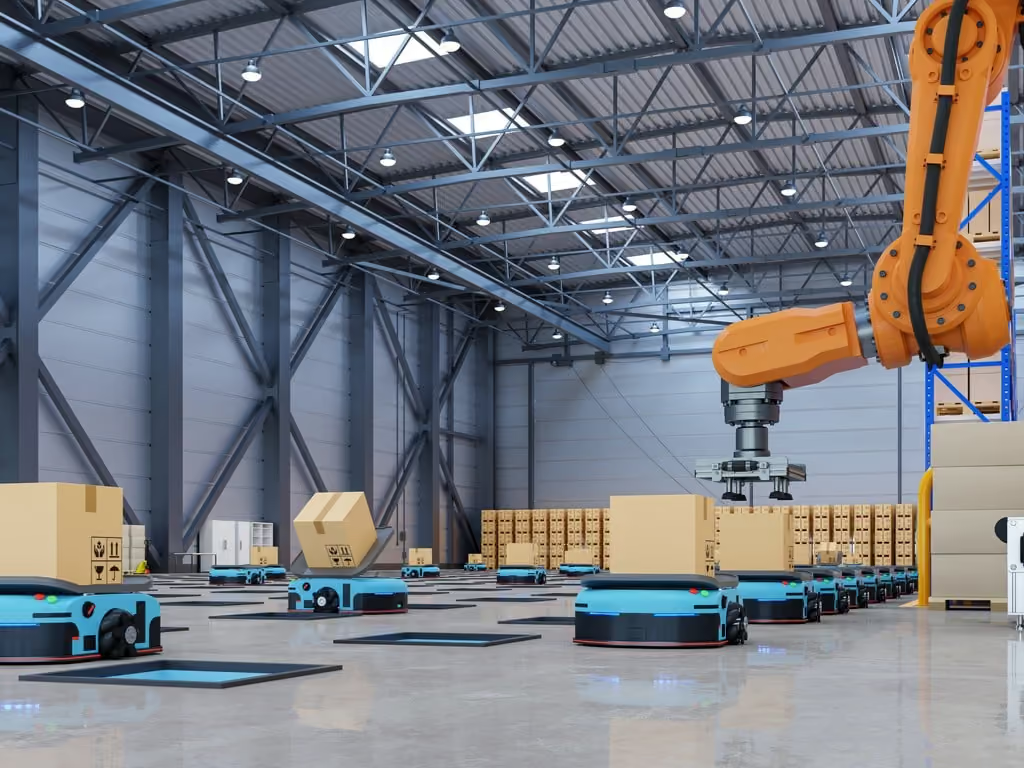
Automation raises the importance of predictable network behaviour. Robotics, AGVs, AMRs, machine vision and edge AI may increase east-west traffic, depend on consistent mobility or require local processing to continue when a WAN service is unavailable.
We begin with the use case, failure tolerance and safety boundaries. Fixed and safety-critical connections should remain wired where feasible. Where wireless is necessary, the network must be designed and tested against the actual route, device and workload. This protects the investment from a common failure pattern: a pilot works in one controlled area, then becomes unreliable when scaled across live production.
6) Visibility and controlled day-two change
A factory changes after handover. Lines move, suppliers update equipment, device fleets grow and new applications introduce different traffic. Monitoring, configuration standards, documented baselines and controlled change help the network remain dependable as the operation evolves.
Useful visibility goes beyond showing that switches and access points are online. It should help engineers identify what changed, which production service is affected and what safe action is available. We can provide commissioning records, topology and RF documentation, validation evidence, support and targeted reassessment after material operational changes.
How does Oxspring deliver a factory network project?
Discover. We map production processes, critical lines, systems, protocols, mobile routes, environmental zones, supplier dependencies and planned change. This establishes where connectivity matters and what failure would mean operationally.
Assess and survey. We review the existing LAN, wireless, WAN and security environment; identify single points of failure and unclear trust boundaries; and gather evidence using configuration, monitoring, spectrum and site-survey data as appropriate.
Design. We develop the wired, wireless and security architecture together. The design can include switching, fibre, cabinets, Wi‑Fi, specialist wireless, segmentation, resilient site connectivity, management and explicit acceptance criteria.
Plan the change. We phase migration around production constraints, other contractors and available maintenance windows. Representative pilots, rollback routes and clear ownership reduce the risk of introducing an untested dependency.
Install and commission. Our engineers coordinate work on live sites, apply the agreed change controls and document the implemented environment.
Validate. We test what matters to the operation: critical-path reachability, failover, segmentation, authentication, coverage, real-route roaming and application behaviour. The result should be evidence against agreed criteria, not only confirmation that equipment is powered on.
Support and improve. We hand over usable documentation and can provide monitoring, technical support, lifecycle advice and reassessment as the site, production process or digital roadmap changes.
Proven in manufacturing and automation environments
Oxspring has worked with Cisco networking technologies for over 25 years. We combine that platform experience with practical delivery across live factories, industrial wireless environments and operationally constrained projects.
- Supporting ERP/MRP data collection across a 40,000 sq ft factory. A Yorkshire manufacturer needed Honeywell handheld terminals, mobile computers and label printers to roam across its factory and offices as part of an SAP ERP/MRP programme. We used pre-installation design and post-installation Ekahau validation, then delivered 13 managed Wi‑Fi 6 access points with the associated cabling, commissioning and handover. Read the project.
- Designing low-latency wireless for around 80 automated picking robots. The application required continuous connectivity, with as many as 40 robots in one area and a sub-2-millisecond latency requirement. The design used directional antennas, careful access-point placement and high-density RF planning around radios installed approximately one metre above the floor. Read the project.
These examples show the design constraints and methods used. Where a project page does not yet contain measured operational outcomes, we treat its figures as requirements and delivery evidence rather than claiming results that have not been published.
Related guidance
- ERP/MRP shop-floor data collection: the hidden network requirements
- How enterprise networks improve factory uptime and safety
- How to scale factory networking for UK digital transformation
- How to scale resilient manufacturing networks across UK sites
- Wireless technology recommendations for complex manufacturing environments
- Why your network will decide whether AI delivers in your warehouse or factory
- Industrial Wi‑Fi challenges in warehouses and factories
Frequently asked questions
What is a connected factory?
A connected factory uses a deliberately designed wired, wireless and secure network architecture to connect production equipment, people and business systems. It supports required data flows while maintaining appropriate boundaries between OT, IT, suppliers and other device groups.
Where should a factory network improvement start?
Start with production dependencies and evidence. Map the workflows that must not fail, the systems and communication paths behind them, current incidents, planned change and the consequence of losing each service. This usually reveals a more useful first step than beginning with an equipment list.
Do we need to replace the whole network?
Often not. Targeted improvements to resilience, RF design, segmentation, identity, monitoring or documentation may reduce risk faster than a wholesale replacement. Lifecycle and support issues still matter, but replacement should follow evidence and operational priorities.
How should IT and OT networks be separated?
Define the communication that production, engineering, enterprise and supplier systems genuinely require, then enforce those paths through suitable segmentation and access controls. An industrial DMZ may provide a controlled exchange point. The design should be understandable, testable and supportable by both IT and operational teams.
Is Wi‑Fi suitable for production equipment?
It can be suitable for many operator, HMI, scanner and mobile workloads. Fixed and safety-critical systems should remain wired where feasible. Mobility-critical equipment needs a technology choice and validation method based on its latency, roaming, resilience and failure requirements.
Does every factory need private 5G?
No. Private cellular is justified when the use case, footprint, device ecosystem or service requirements cannot be met more simply by wired connectivity or well-designed Wi‑Fi. It should follow a requirements assessment rather than a technology preference.
Can legacy industrial equipment remain in service?
Often, yes. A phased architecture can retain supportable legacy assets while placing clearer boundaries and monitoring around their communication paths. The decision should consider lifecycle risk, protocol dependencies, security and the operational value of replacement.
How can suppliers access machines securely?
Use attributable identities, strong authentication, least-privilege permissions, controlled entry points and time-bounded access. Record and review activity, and remove permissions when the work ends. Avoid permanent broad access from uncontrolled supplier devices.
What should be tested before accepting a factory network?
Acceptance should reflect the operation. Tests may include critical-path availability, device and circuit failover, segmentation, authentication, real-route wireless roaming, application performance, monitoring alerts and rollback. A predictive design or static coverage map alone is not enough.
How can several factories use a common architecture?
Standardise principles, policy, documentation and acceptance criteria, then assess each site’s production flows and physical conditions. This creates repeatable governance without assuming that every factory needs identical hardware or topology.
Start with the production requirement
If you are modernising a factory network, extending ERP or MRP onto the shop floor, introducing automation or trying to resolve intermittent production connectivity, we can help turn the operational requirement into a practical network plan.
Email solutions@oxspring.com with the subject “Connected Factory”. Tell us what the site produces, which systems or workflows depend on the network, where reliability or security concerns are appearing and what is changing. We will arrange an initial Teams call, with no cost or obligation, to understand the problem and determine the most useful next step.